

Appearance
LCD
LCD distributes color and light through an array of cell apertures. Their shapes determine how that light reaches the output pixels.
Light and Strong are different apertures
Strong distributes each cell's color through three horizontal RGB emitter apertures and a vertical cell response.
Light uses the same achromatic cell-response shape on both axes. The aperture weights are achromatic; the game keeps its colors. Unequal X and Y presentation pitches can still stretch the shape.
Mina the Hollower
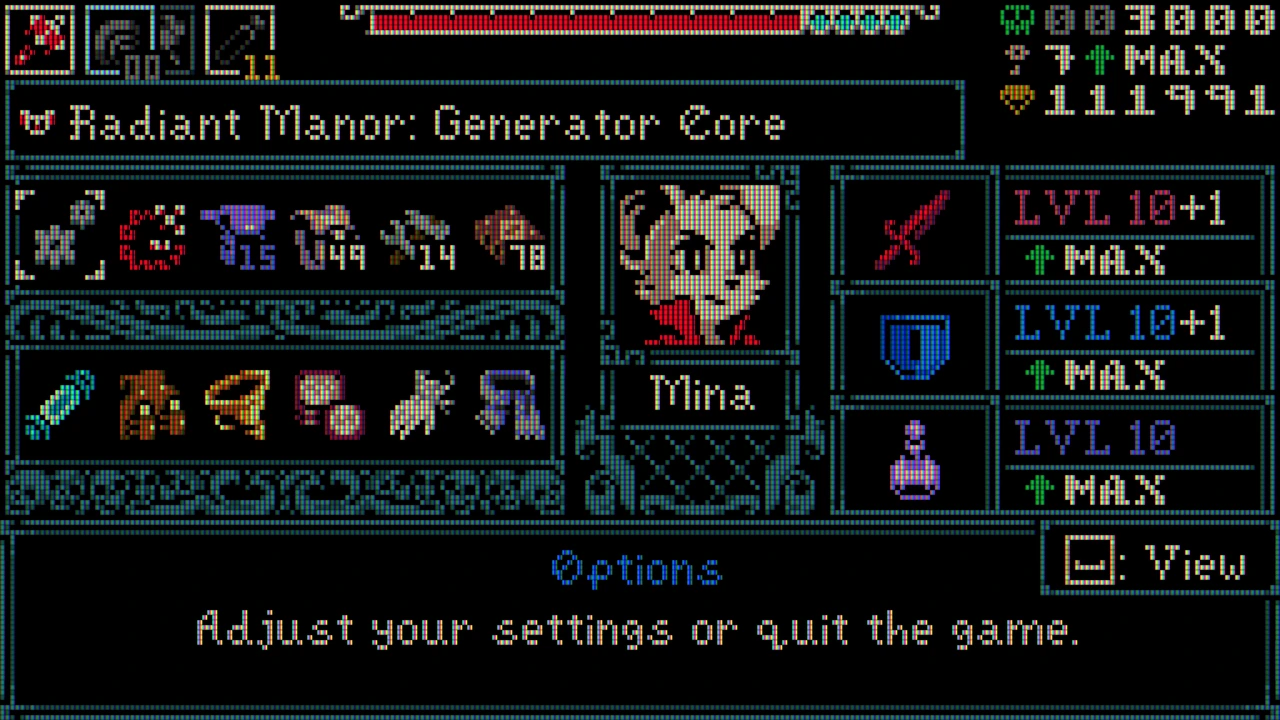
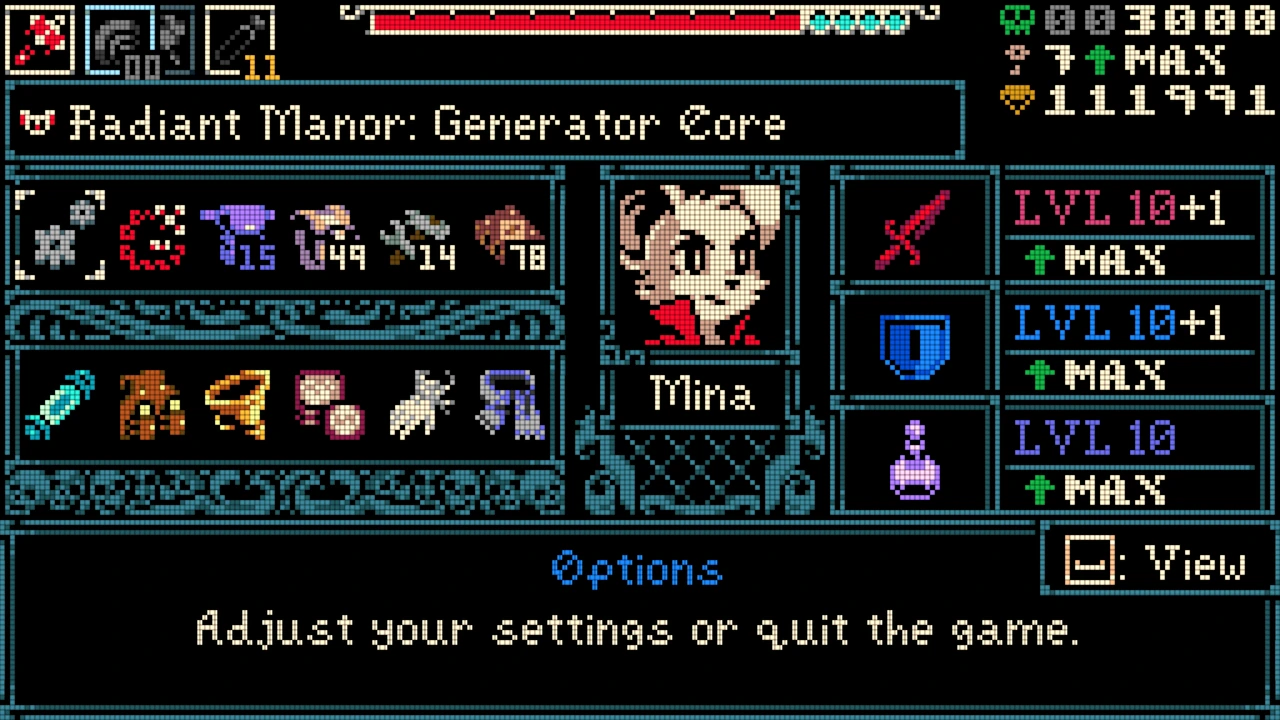
Ghosting is a separate temporal choice
Ghosting successively mixes the pristine frame with up to seven preceding pristine frames before source transfer and panel processing. Older frames contribute less. Keeping treated images out of the history prevents the aperture pattern from accumulating.
Ghosting starts fresh when LCD restarts or the picture’s geometry changes. The first frame uses only the current image; the trail builds as new frames arrive.
Apertures, pitch and phase
Pitch says how far apart cells are. Phase says where they begin. LCD uses both to position each aperture within its cell.
For presentation coordinates x and y, the conceptual mapping to cell coordinates is:
text
q_x = (x − phase_x) / pitch_x
q_y = (y − phase_y) / pitch_y
Pixel-center and cell-center offsets determine which neighboring apertures overlap an output sample. Changing the origin moves the dark boundaries and Strong's colored emitters while leaving pitch unchanged. Light is subtler, but just as dependent on phase.
Aperture coverage
LCD evaluates smooth aperture profiles and integrates them across the output pixel's footprint. With pitches px and py in output pixels per cell, that footprint is approximately 1/px by 1/py in cell coordinates. Strong's horizontal emitter coordinate advances three times as quickly, because one cell contains three emitters.
Conceptually, one axis contributes an average over the pixel footprint:
text
coverage = aperture integral
           / footprint width
Differences of polynomial antiderivatives give the coverage directly. Horizontal and vertical contributions combine across neighboring cells, using the same calculation at integer and fractional scales.


When the output cannot resolve the panel
An aperture can be smaller than an output pixel. Drawing its full contrast at a single sample center would make the result depend too strongly on alignment: a small phase shift might put a sample inside a bright emitter one moment and between emitters the next.
At generous scale, separate cells and Strong's RGB structure are visible. As each output pixel covers more of a cell, integration averages over the aperture's peaks.
Strong divides horizontal cell space among three emitters, so its color structure demands more horizontal sampling bandwidth than Light's single achromatic aperture.
Integration handles aperture coverage more faithfully than a point sample, though some grids, scales and later resizing can still alias.
Fewer pixels per cell
If the selected cell dimensions stay fixed while output resolution falls, fewer output samples cover each cell. Non-integer or anisotropic scaling changes the two axis footprints independently. A cell shape that is well resolved horizontally can still lose its vertical structure, or vice versa.
Screen fallback uses approximately one output pixel per cell, so its structure may be muted or unresolved. Detect or Manual can set a different treatment scale without adding image detail. Virtual also changes the working image raster. Choose a lower grid for coarser treatment cells.
Phase still changes aperture coverage near the output limit. The phase-only LCD comparison shows how a chosen spacing-only anchor can misalign the cells.
Inspect fine patterns at native size where possible. Browser scaling, screenshot resizing or another display transform can add a second sampling problem after Beamline's output. A reduced image may show patterns absent from the native capture.
Grid choices
With a detected grid, LCD samples color at the presentation coordinate and applies aperture coverage. The camera and sprites can move beneath the fixed cell pattern without snapping to inferred cell centers.
Virtual Raster creates synthetic cells from four reads of the presented image. LCD can use those cell colors for neighboring-cell reconstruction.
A strict calibration measures presentation pitch and phase. The spacing-only fallback uses a Manual-equivalent anchor instead. LCD can use this grid, but the chosen origin may misalign cells with the image.