

Appearance
Scanlines, masks and sampling
There are at least three lattices in this picture: the game's presented image structure, the structure Beamline draws, and the output pixels available to represent it. They need not coincide. A mask that looks fine in a large image can become a coarse beat pattern after reduction, even though its formula has not changed.
What the grid controls today
For a treated content extent W × H and selected grid dimensions Lx × Ly, the corresponding pitches are W/Lx and H/Ly. Core and Studio use the vertical spacing for beam density and low-scale filtering. Studio's shadow/slot-style material periods also depend on horizontal and vertical spacing; Core does not draw these masks.
CRT anchors its scanlines and masks to presentation/content coordinates. Its internally calculated raster phase ignores detected X/Y phase.
That also lets CRT use spacing-only calibration.
With a detected grid, reconstruction samples presented color continuously and optics samples response images by presentation row. This avoids snapping camera motion to inferred cell centers.
Virtual Raster supplies a different kind of input: a synthetic cell image that Beamline manufactures before CRT reconstruction, with its own dimensions and treatment scale.
Structure that survives the output


Dots mark output sample centers; gray cells show footprint averages.
The Binding of Isaac


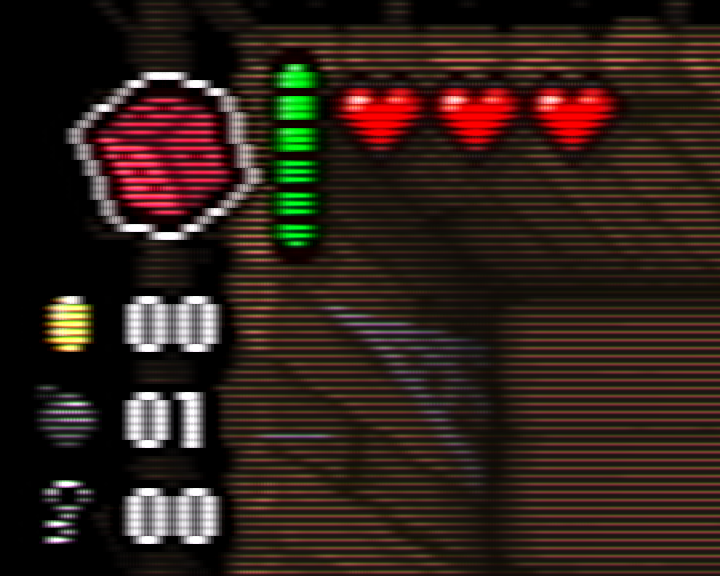

Both styles vary beam shape and contribution with brightness. Studio adds intensity-dependent shadow/slot-style masks.
The optical stage integrates mask coverage over each output-pixel footprint. It also reduces modulation as a material period approaches the output sampling limit, fading from full modulation at four samples per period to its mean at two. Maintaining a strong alternating pattern at that boundary would make the result excessively dependent on which pixel centers happened to sample it.
Scanlines have their own low-scale filter. From four output samples per logical row toward three, the beam reduces unsupported harmonics. Toward two and below, it approaches a phase-neutral energy mean, reducing uneven bands from unresolved row structure.
Curvature changes the local sampling footprint again. The optical beam accounts for that footprint, and the terminal presentation filters the warped completed picture. Those are complementary operations, discussed in Curvature, bezel and reflection.
Grid modes
The overlay’s grid modes choose the treatment scale. Screen uses output-sized geometry, where fine CRT structure may be attenuated. Virtual also supplies synthetic cells for reconstruction, as described above.